Updated on December 9, 2025
The Twelve Apostles, Loch Ard Gorge, London Bridge…
The Great Ocean Road is renowned for its winding, cliff-hugging drive, culminating in the spectacular and rugged coastline of the Port Campbell National Park, home to the Twelve Apostles, Loch Ard Gorge, Gibson’s Steps, and numerous other stunning natural attractions.
Twelve Apostles Marine National Park
The Twelve Apostles Marine National Park was established in 2002. In total, 75 km², covering 17km of the Victorian coastline. The spectacular formations are not just found above the waterline. Incredible underwater scenery, including arches, fissures, and reefs, makes up much of the breathtaking environment beneath the Southern Ocean.
What are the Twelve Apostles in Australia?
The 12 Apostles are an Australian icon. The Ocean Road drive is likened to the coastal road of California and often ‘declared’ the best road trip in the world, somewhat overstated perhaps. Is there any such thing as ‘the best road trip’ in the world? It is fabulous, dramatic, and worth visiting, though.
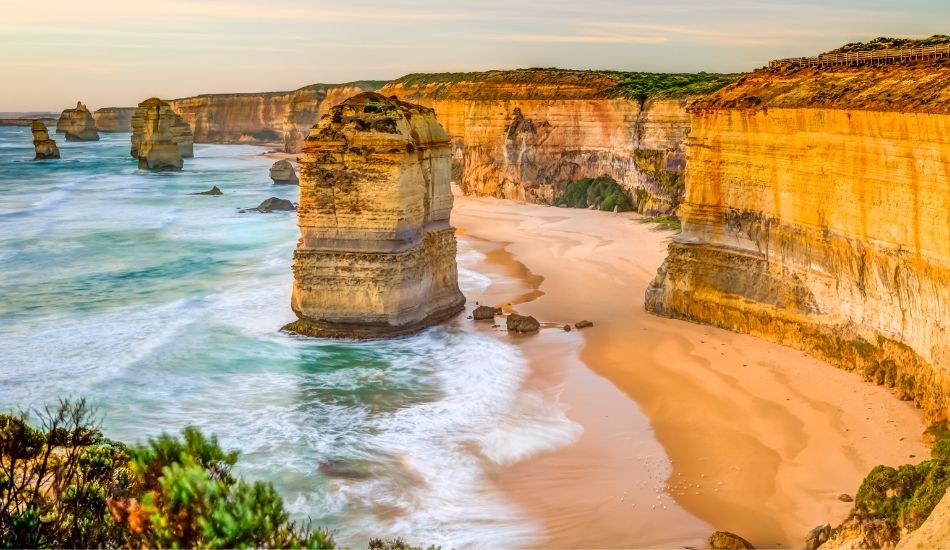
Limestone pillars, once connected to the cliffs of the Port Campbell National Park, rise out of the sea. Carved out over many thousands of years through the natural forces of nature, firstly as caves, then into arches and eventually becoming the limestone stacks we see today.
Further along the coastline, ‘The Arch’, ‘London Bridge’, ‘ The Grotto’ and ‘Bay of Martyrs’ are more reminders of how the coast constantly changes.
Find the perfect itinerary to suit your adventure, whether self-driving or by tour bus.

Where are the 12 Apostles?
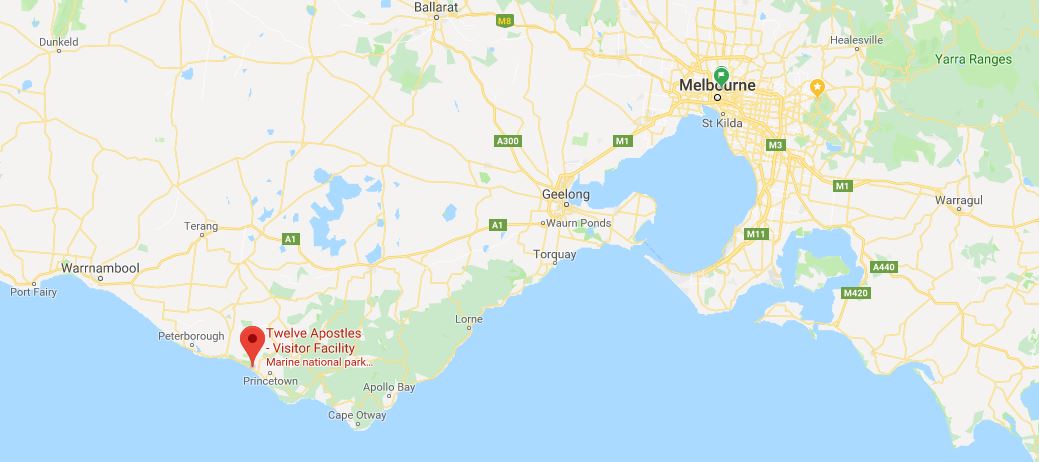
The 12 Apostles are located within the Port Campbell National Park, Victoria. The distance from Melbourne is 227.5 km / 2 hours 50 minutes on the fastest possible route, or 277 km, which takes 4 hours 25 minutes on the scenic coastal drive (definitely the best option). These times are driving only, without any stops.
How many of the 12 Apostles are left?
There are now six of the 12 Apostles rock formations visible from the central viewing platform.
From the other end of the viewing area, two more stacks can be seen along Gibson’s Beach, but these are not part of the ‘official’ count as they are known as Gog and Magog.
We do not actually have Twelve Apostles; it is confusing as to which ones are ‘officially’ called the 12 Apostles, as opinions differ.
The crumbled remains of two of the rock stacks can be seen from the viewing platform and some are out of sight.
It goes without saying that the experience remains amazing, regardless, and a trip down the Great Ocean Road to the 12 Apostles is certainly worthwhile, making it one of the most popular road trips in Australia.
There are more limestone rock stacks along what is known as ‘The Shipwreck Coast’, including some smaller ones in the Bay of Islands Coastal Park, located further along towards the town of Warrnambool.

Why are they called the Twelve Apostles?
The ‘Sow and the Piglets’ was the name previously used to describe these beautiful formations, not a terribly romantic title at all. The Sow was what is now called ‘Mutton Bird Island’ in the Loch Ard Gorge section of the park, and the piglets were all the other rock stacks.
The short-tailed shearwater, or muttonbird as it is often known in Australia, migrates 1000’s of miles south from the Aleutian Islands to nest along the coast during the Aussie summer. The sight of these sea birds coming into their nests each evening after searching for food for their chicks is one of the lesser-known attractions at Loch Ard Gorge.

As the coastline changes, so do some of the names of formations we have come to know.
At Loch Ard Gorge, what was previously known as ‘The Island Archway’ is now known as ‘Tom and Eva’ after the arch collapsed, creating two new islands. Tom and Eva were the only survivors from one of the most famous shipwrecks, The Loch Ard in 1878.
When is the best time to visit the 12 Apostles?
The 12 Apostles attract more visitors than any other location along the Great Ocean Road; daily visitor numbers peaked at 11,000 during the recent Chinese New Year.
Those numbers were extreme, but it does get insanely busy, especially when Melbourne day tour buses arrive in the mid-to-late afternoon. Sunset is also very busy. The quietest time is early morning, at any time of the year, though there will always be other visitors present at dawn as well.
The summer holidays (from Christmas to the end of January) and Easter are the peak times. Winter, however, attracts fewer crowds and can be an excellent time to experience the area.
Tips for your visit to Port Campbell National Park
- Free Parking is plentiful at the 12 Apostles visitor centre.
- Toilets and drinking water available at the centre, 24 hours.
- There is a small kiosk/gift shop at the centre, which closes at 5 pm – crazy for such a famous attraction.
- Accommodation and cafes/restaurants (even a microbrewery!) can be found in Port Campbell, a 12-minute drive away.
- There is a 2 km, gorgeous, walk along a well-made path to Gibson’s Steps from the main visitor centre.
- Take this road trip over at least 2 days so that you have time to relax. Read our one-day itinerary for an idea of what to expect and how much you can see.
What to See & Do at The Twelve Apostles
There is more to see and do in the area than just viewing the famous rocks stacks – follow walking trails, walk along beaches, visit a historic cemetery at Loch Ard Gorge and learn more about the region.
1. Gibson’s Beach – This is a must-do!
This is the first stop when arriving at the Port Campbell National Park from the Melbourne direction, and one of the best beaches to visit for dramatic scenery.
It is not safe for swimming, though surfers can often be seen there. 88 steps lead down the cliff face to the ocean, and two of the famous rock formations, known as Gog and Magog, can be seen.
High above the beach at the western end, one of the 12 Apostles viewing platforms can be seen. The steps were hand-carved into the cliff over a century ago, but were concreted for safety in the 1990s.


When the tide is exceptionally high, the steps are closed off, as there is very little of the beach available to walk on; otherwise, it is a fabulous spot to relax and view the limestone cliffs from sea level.
Parking is minimal at Gibson’s Steps. If it is busy, drive 2 km to the large parking area at the Apostles Visitor Centre and follow the 2 km coastal path back; it is signposted clearly and makes for a lovely, easy hike.

2. The Twelve Apostles viewing area
You don’t need to introduce these icons of the Great Ocean Road! There is plenty of room on the viewing platforms, although it can get crowded; the busiest time is typically mid-to-late afternoon.

2a. Helicopter Flights
It is incredible to finally see these famous rock stacks from the viewing platform, but how about from above?
- Scenic helicopter flights leave from near the 12 Apostles visitor centre behind the car park.
- Or how about a flight from Apollo Bay? These trips follow the coast, passing the Cape Otway Light Station and parts of the coast that you can’t see or access from the road. Apollo Bay Aviation provides a variety of trips; read more on their website.

3. Loch Ard Gorge
This area is awesome, just a 5-minute drive from the 12 Apostles. The walks to the well known ‘Razorback’ formation, past ‘Tom and Eva’ along a path to Shipwreck lookout and down into Loch Ard Gorge and the beach are the most popular, if you have time, walk on to the small cemetery, Mutton Bird island viewing platform, Thunder Cave and down to the Sherbrook River where it meets the southern ocean.


Tips:
- No toilets or visitor facilities at Loch Ard Gorge
- Swimming is allowed on the beach at Loch Ard Gorge, though at your own risk.
- Do not swim in the water at the Sherbrook River, as the current is powerful and dangerous.
- Watch out for snakes, do not approach if you see any, leave them alone and they’ll generally leave you alone too.

Doing all the walks at Loch Ard Gorge takes a few hours and covers about 8 km of trails, but it is one of the most spectacular places to visit.
We spent over three hours here recently, taking our time to see every lookout, walking down to the Sherbrook River to watch the waves crashing in.
SAFETY WARNING
Never underestimate the power of currents and waves, and never overestimate your own strength and abilities. The seas can be treacherous, and it takes just a split second to get into trouble and be swept off the rocks or the beach and out into the ocean. Even going in just waist-deep can be catastrophic.
On the 21st April 2019, two volunteer lifesavers from Port Campbell, a father and son, lost their lives trying to save a tourist who was swept into the sea from this area. The rescue boat overturned in a 2-meter swell, a third rescue volunteer survived, and the tourist was winched to safety.
4. The Arch | 5. London ‘Bridge’ | 6. The Grotto
A short drive from Port Campbell, on the road to Warrnambool, is even more formations well worth visiting.
The Arch involves a short walk to a viewing platform. London Bridge, now known as London Arch, always attracts crowds and ‘The Grotto’ is an especially interesting formation to walk down to.

Australia’s ‘London Bridge’ fell down in 1990
A formation that was for decades known as ‘London Bridge’ had a connecting arch collapse in 1990, leaving two unsuspecting travellers stranded on the newly formed island. A couple of hours later, they were rescued by helicopter.
It was fortunate that there was no one on the section that fell into the sea. It is now referred to as ‘London Arch’.

Bay of Islands Coastal Park & Bay of Martyrs
Further along the road, the Bay of Islands Coastal Park is near the end of this incredible coastal drive and less than an hour from the town of Warrnambool, well known for whale watching. Along with the Bay of Martyrs, this area is well worth visiting. Follow the historic trail of the Bay of Martyrs, walk on the beaches…
The Shipwreck Coast
Immigrants and supplies were brought to the country via what was a major shipping route through the Bass Strait. Many ships would sail via Cape Town, across the Southern Ocean and through what was described as the ‘eye of the needle’ – the relatively narrow gap between King Island and Cape Otway.
It was a treacherous part of the journey; over 200 ships came to grief along this section of the Victorian Coastline.
The 12 Apostles Information Centre in Port Campbell features a small-scale model of the most famous wreck, ‘The Loch Ard’, which sank in 1878 with only two survivors: a cabin boy named Tom and a young passenger named Eva. The historic shipwreck display at the centre is worth visiting.

Flagstaff Hill Maritime Museum and Village in Warrnambool is an extensive museum that displays many shipwreck artefacts recovered from some of the 200 ships that came to grief along the coast.
Items range from everyday products owned by passengers, ship items and a Peacock statue from the Loch Ard wreck, valued at $4 million. The peacock was designed by Paul Comolera in 1873 and fired at the Minton pottery at Stoke on Trent, England. It was destined for the International Exhibition of 1880 in Melbourne.
Where does the Great Ocean Road Begin and End?
Once travellers reach Torquay, the Great Ocean Road begins, the Bass Strait finally comes into view, and the adventures begin. The road goes past Bells Beach, where surfing legends are made, then winds on down to the little towns of Anglesea and Aireys Inlet.
It continues all the way for miles and miles along the coast and inland through forests and farmland before reaching the Port Campbell National Park and the 12 Apostles.
Port Campbell is about 12 minutes from the Apostles, and then it is less than 20 kilometres further, with a few more sights to be seen before the Great Ocean Road essentially ends near the little town of Allansford and the Bay of Islands.
| ROUTE | DISTANCE | TRAVEL TIME |
|---|---|---|
| Melbourne to Torquay | 104.5 kilometres/ 65 miles | 90 minutes |
| Torquay to Lorne | 46 kilometres / 28.5 miles | 50 minutes |
| Lorne to Apollo Bay | 47.3 kilometres / 29 miles | 60 minutes |
| Apollo Bay to Lavers Hill | 51.4 kilometres / 32 miles | 50 minutes |
| Lavers Hill to 12 Apostles | 40 kilometres / 25 miles | 45 minutes |
| 12 Apostles to Port Campbell | 11.2 kilometres / 7 miles | 10 minutes |
| Port Campbell to Colac | 77.6 kilometres / 48 miles | 60 minutes |
| Colac to Melbourne | 152 kilometres / 94.5 miles | 2 hours |
| TOTAL TIME | 8 HOURS DRIVING |
Melbourne to the Twelve Apostles
The drive directly along the coast to the Twelve Apostles is over 4,5 hours, non-stop. Read our one-day self-drive itinerary to find out the best places to stop along the way and to get a realistic timetable so that you can see everything along the way.
Take a few days to tour the coast, which will allow you time to drive inland and see some beautiful waterfalls and a cool temperate rainforest.
Apollo Bay to the Twelve Apostles
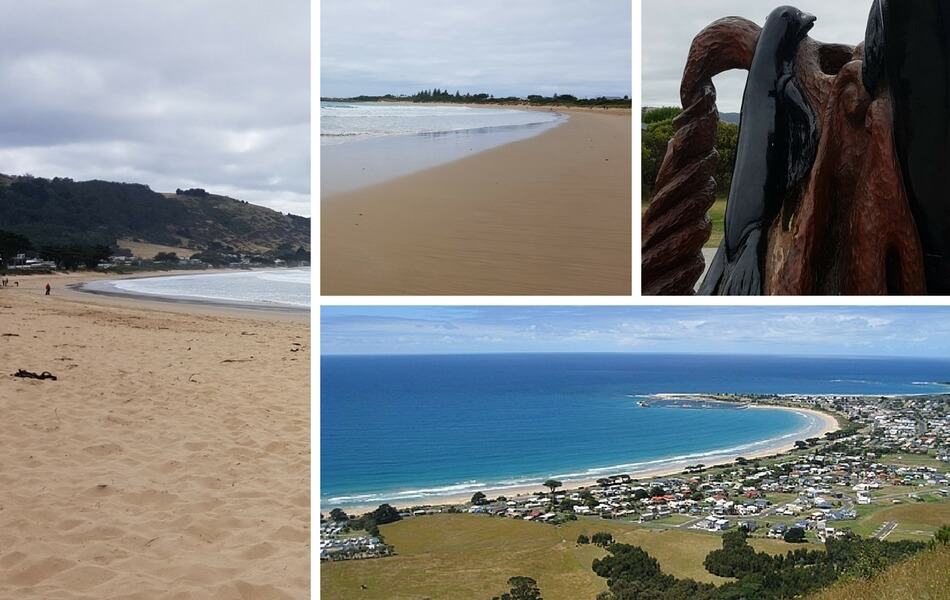
Apollo Bay is often used as a holiday base, as well as a starting point for drives into the rainforest, featuring waterfalls and walking trails. It features a stunning, long beach that is safe for swimming and water sports.
From the town, it is about 90 90-minute drive / 87 km to the Port Campbell National Park, which can be done as a day trip.
There is so much to do once in the 12 Apostles area, aim to leave Apollo Bay early enough to be able to enjoy the experience and, preferably, return to Apollo Bay before dark if you are using it as a base. Otherwise, there is plenty of accommodation and camping at Port Campbell, a short drive from the 12 Apostles.
The road goes inland through forest and farmland before climbing to the top of the Otway Ranges at Lavers Hill, then descending through more forest and farmland to the coast again.
Cape Otway, with its historic lighthouse to climb, is another perfect day trip destination from Apollo Bay, ideal for those using the town as a holiday base or when time is available during a tour. Some good walks in the area, too, and beaches to explore, such as Blanket Bay. Koalas are plentiful at Cape Otway, too, and are usually easy to spot.
Twelve Apostles Accommodation
Finding accommodation near the 12 Apostles is easy; most motels and cabins are located in Port Campbell, which is a 12-minute drive from the Port Campbell National Park, home to the Twelve Apostles, Loch Ard Gorge, and Gibson’s Steps.
Camping and caravan parks (including some lovely free campsites) are plentiful along the Great Ocean Road and inland, up in the Otway National Park..
Motel and Cabin Accommodation – Port Campbell
We love staying at the Sea Foam Villas when it is just the two of us, and have enjoyed staying in the family cabins at the Port Campbell Holiday Park with the kids. Port Campbell offers a range of accommodation options.

Great Ocean Road Map & Itinerary Planner
There is so much to see along the Great Ocean Road: beautiful beaches, waterfalls, seaside towns, cool-temperate rainforest walks, historic lighthouses, koalas in the wild, and kangaroos.
It is essential to be aware of how long the journey will realistically take. Driving the return route as a day trip from Melbourne covers over 500km and can be tiring.
You can use our map of 50 of the best things to see and places to visit along the Great Ocean Road, as well as the best stops to make for spectacular views.
Driving Melbourne to Adelaide via the Great Ocean Road?
Driving from Melbourne to Adelaide or vice versa? Follow our 5-day self-drive itinerary via the Great Ocean Road.
Take your time, enjoy this incredible coastal drive, breathe in the salty air, and the earthy scents of the cool temperate Australian rainforest…